Sunday, 18 September 2022

For Queen, country...and Otherworld!


The first version on the Captain Britain Omnibus was released on the 21st October 2021, a fine collection of of the good Captain's adventure, but it was missing some of the pre Excalibur stories thus making it feel slightly incomplete. Fan didn't have to wait too long for the second edition to be released with it bulging new Alan Davis cover that contained the rather more all encompassing history of Mr Braddock, from his humble beginnings in Captain Britain Weekly to his guest appearances in The New Mutants Annual #2 (October 1986) and The Uncanny X-Men Annual #11 (1987), this version hit the shelves in April 2022. Omnibus editions are heavy, expensive and extravagant, only for fanatic followers. However if you can live with the weight they offer a cheaper option than buying over priced back issues. They give a historic insight into their chosen subject with behind the scenes articles, extra covers, posters, artist sketches and so much more. Personally I have a cherished complete run of the original comics so is there really a reason to buy this edition? Damn right there is! I found lots of new story versions and extras I've never seen before making it an absolute treasure trove not to be missed.

I first encountered the lion of Britain was on the back cover of Super Spider-man and the Titans #203 in a Merry Marvel Christmas pin up by George Mina in 1976. I was intrigued by this new hero standing front and centre. As a six year old I hadn't begun my comic collecting life and would have to wait 'till I was older to collect his first weekly exploits as back issues. 


No the first time I passed over my pocket money for any patriotic comic goodies was for the Captain Britain Summer Special from 1980, enticed by its stunning cover with the central image of our hero flying into action by Pablo Marcos, a college of contents by the knife and glue of Dez Skinn and Paul Neary. The back cover also left an impression on me, I probably learned to draw from that poster of Captain's Britain and America by The King, Jack Kirby. Inside was filled with reprints of Captain Britain  from his weekly and British produced Black Knight stories that guest star the captain from Hulk Comic. New articles about the Knight and CB lit the bonfire of my interest, these can be found in the Omnibus.

Lets start at the beginning of the Omnibus, the original weekly comic proclaimed that it was in full colour, this wasn't completely true, only the Captain Britain strip was,(the Fantastic Four strip had to settle for black and white while the end Nick Fury strip gained colour) although due to an editorial mistake the last page of CB strip was in black and white with a text line offering the reader to colour it in as a bonus feature! Chris Claremont wrote and Herb Trimpe drew this tale which kind of felt rush and out of order in some ways, but completely intriguing  in other ways because of how it starts with the action and goes back to his origin. The early tale where re-edited and fully coloured with new splash pages for the US comic Marvel Tales (131-133) in 1981. These stories are also printed in the Omnibus and give another insight into the Captains origin. Claremont lasted 10 issues, but they weren't earth shattering. Just enough to set out Brian Braddocks background and make the first appearance of his sister Betsy, the future X-Man Psylock. Gary Friedrich took over the writing chores and Trimpe continued to give a fair account of an action hero strip.


Things really improved when John Buscema and Tom Palmer took over as artists with issue 24, but at the price of colour. Buscema's artwork shines in monochrome with subtle shading giving more character to the strip, although I wonder if coloured version might have been a nice touch with this Omnibus? Possibly not as I really can't fail these strips. Writers and artists come and go, Larry Lieber,  Len Wein and Jim Lawrence took up the typewriter with Ron Wilson and Pablo Marcos on art duties. Stories raise and fall in quality but still there are some gem moments.


Colour briefly returns to the Omnibus with the Chris Claremont and John Byrne classic Marvel Team-Up #65. I originally read this in black and white in another much treasured Captain Britain Summer Special from 1981, it was first premiered in the UK in Super Spider-man and Captain Britain after CB finished his original run, strangely enough never making it to the cover of those issues. Byrne's redrawing of the Captain's origin, feels like the definitive version, improving on Trimpe with Claremont getting another go at getting it right. This story also makes the debut of Arcade and sets up, at least off page the next chapter of Braddocks life story. 


Dez Skinn ramps up the Marvel Revolution with the Black Knight strip that appears in the heavily packed British created content of Hulk Comic, were a mysterious stranger turns out to be Brian Braddock. Steve Parkhouse writes an Arthurian tale that firmly embeds the Captains history in an Otherworld, beautifully drawn by John Stokes and Paul Neary. Here we get to see Captain Britain die for the first time! Again I wonder if these tales should be re-coloured for this edition but once again the detailed beauty of the black and white artwork might get lost so I'm happy they kept the originals. 


Time for a rebirth! The Captain gains a new costume and his most associated artist- Alan Davis, in a new comic, Marvel Super-Heroes #377. Dave Thorpe takes Brian back down to earth with this dark 80's Britain modern setting. A mixture of 1984, The Avengers TV series, Alice in Wonderland and Thatchers Britain, where all is not well in this political Orwellian world. This is Davis' first professional work, but already it looks like the work of an artist we know and love. Originally it was printed in black and white but this Omnibus chooses to print the coloured version from X-Men Archives. Davis' work is stunning in black and white, its also stunning in colour so why not print the colour version. Things were things were bleak and twisted. Things were about to get more crooked and warped!


With issue 387 of Marvel Super-heroes a new writer picked up the typewriter and changed the comic world as I knew it. You won't find his name in the credits of this Omnibus or many of his other works. Mostly credited as the original writer, or complete deleted from any credits due to his personal request. But his name is Alan Moore. And he is the greatest writer of comic fiction ever! Well possibly, well maybe, well...well I really love his stuff! Within two issues he has twisted reality to breaking point while laying clues for the future and finally killing off our hero in a Fury. But Alan Moore is like an insane angry child who kicks over his toys and puzzles in a play room, then calmly sits down and rebuilds them to make them better. I've always known what Alan Moore was and how he wrote but I could never but it into a simple word or phrase, however while listening to the never iron anything podcast I heard Tony Esmond call him "The Great Adaptor!" That perfectly sums up the man. I'm stealing that! Moore does the work, he really looks into the character past and works him out. He takes all the small parts of the characters backstory and creates a bigger and better picture. You don't realise he's doing it until the climax has been reached. In issue 388, the last issue to feature a Captain Britain strip before it continued in The Daredevils #1, Moore wrote an article titled "A short history of Britain." in which he waxed lyrical about Captain Britain's  history though the Marvel comics. It was insightful and would have made a smashing inclusion in this Omnibus, but I guess he wouldn't allow them to reprint it, which is a shame but fair enough. I'm just glad I've read it in that mag. 


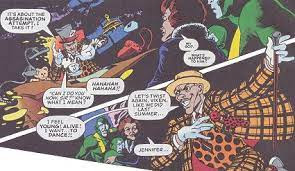
Moore cherry picked from every previous version of Captain Britain. Merlin and Lady Roma from the very beginning, Mastermind, Betsy and Jamie from those early issues. After seeing her gang we finally got to meet Vixen. We got more of S.T.R.I.K.E. and the Slaymaster. He reintroduced the Special Executive from old Doctor Who weekly back up stories. The Crazy Gang, Mad Jim Jaspers and the crooked worlds Captain UK made an important return. All old but new and engaging. Magic is science in the Marvel Universe was Moores idea, numbering earths was Moores too,  everyday normal becomes nightmares that's  all thanks to Moore. He adapts tales and characters while others just copy. 


All good things come to an end and so Alan Moore finish his time with the Captain. It's not a sad time 'cause all the while another Alan has been taking notes as he delivers the amazing artwork. Alan Davis steps up and in truth you don't see the joint. Taught by the master "Bad moon rising" and "Tea and sympathy" are seamless as what came before. The strip had gone from Marvel Super-Heroes to The Daredevils and onto The Mighty World of Marvel (Vol 2), now it was time for Captain Britain to get his own comic again. With the help of Jamie DeLano, Alan Davis produces 14 issues of the new monthly. All strong, interesting and enjoyably mature tales. The character had completely grown up and the Moore/Davis version really got it right. Later American writers never fully understood him. If you really love the character don't look anywhere else, this is as good as it gets and this edition has got it all.


The Omnibus also includes a spin off back up strip "The Cherubin", a text story by a young fellow by the name of Grant Morrison and two Mastermind specification scans (fact files to me and you) from the monthly. From Marvel USA the previously mentioned New Mutant and X-Men annuals stories, the first two of many Chris Claremont/Alan Davis/Captain Britain collaborations. Finally the compilation ends with various edits of stories, behind the scene artwork, posters and covers. 


It's only missing "Contest of Champions" and a Captain America story from his comic issues 305-306. The Cap A. issues may have been included in the 2021 version of this Omnibus but removed to make room for more relative content in the 2022 edition. They both don't add to the saga so it's no big loss.


It's complete, it's wonderful, it's an Omni-verse-al Omnibus, it's a must have for a true red, white and blue Captain Britain fan. It just looks so god damn cool sitting on my bookcase, in it's trendy jacket. And my copy is mine all mine! And no I'm not going Mad as Old Jim Jaspers, it's money well spent and I absolutely love it!


Make Mine Marvel!


Sunday, 15 July 2018

Steve Ditko-The Enigma

Steve Ditko sadly passed away on the 29th June 2018, an event that didn't make the general news for over a week later, which was strange but not unbelievable for Steve shunned the spotlight, even though he had created some of the most iconic comic books he preferred to let his simple artwork take all the glory. He never give interviews, wouldn't appear on video or have his picture taken, he give off a persona of a recluse. However there are confirmed stories that when fans arrived asking to see Ditko at his home he would invite them in to chat and sign comics but only after he had made it clear that they weren't reporters and that no pictures of him would be taken.  To most of us he would remain a mystery.

We all know for a fact that he created some of the most amazing and strange characters, comics and stories of all time. Can you imagine a world without Spider-man? I can't! There's so much beauty in his simple but stunningly sophisticated work. Would he be in my top ten artists of all time? Possibly not but his stories would be in my top ten. As a British reader of comics my first encounter of Ditko art came with Spider-man in with the wonderfully clear black and white pages of Spider-man Comics Weekly and later came his psychedelic Doctor Strange as backup in the Avenger weekly. MarvelUKwould frequently use his weird fantasy short stories from Tales of Suspence and Tales to Astonish to fill gaps in their weekly comics, they became regulars in Star Wars Weekly and Doctor Who weekly.  He was truly the master of mystery, his tales always had a twist. He knew how to tell a story, I  personally believe he was responsible for more of that than Stan Lee in their partnership. He created   easy but stunning story board like artwork like the Spider-man trapped under fallen masonry while water floods in after a battle with Doctor Octopus from Amazing Spider-man #33. 
  
I love reading his stories in different formats, one story that I never get tired of reading is The Sinister Six. I treasure this MarvelUK copy of Spider-man Summer Special from 1980. Ditko really know how to create villains. He is responsible for some of Marvel's iconic bad guys, I adore how in this story each villian gets a glorious splash page in battle with our webbed hero.
   
 
Of course Ditko did more than just Spider-man, the Doctor Stange vs Loki is anther of my favourites, which inspired the scenes in Thor Ragnarok between the Thunder God, his brother and the Doctor. 
 
Ditko work was of its time, sometimes his figures would look a little doll like. I never fully loved his later work, even though it was readable. He would return to Marvel in the 80's and work on their toy tie in sci-fi books Rom and the Micronauts. It actually worked well Ditko was master of Sci-Fi as well as mystical,mystery and crime. I do have a soft spot for the Micronauts as the appeared in multiple MarvelUK mags like Star Wars Weekly, Star Heroes Pocket book and Future Tense. 


Steve Ditko wasn't to everyone tastes but that doesn't change the fact that he was a strangely amazing artist and will be missed but never forgotten because of his gigantic body of work. 
Rest in peace Steve.

Make Mine Marvel.


Sunday, 12 June 2016

Adventures in time and space, 500 and counting!

Doctor Who Magazine has just published its five hundredth issue with all the magnificence the Guiness World Record-breaking magazine deserves, in not one but two 116-page magazines, a boxed giant party. Current editor Tom Spilsbury asked readers to showcase their collections, which set Twitter alight with comic stacked high in piles, shelves bulging and floors paved with covers. Why not? From October 1979 to June 2016 is a fantastic run, for many people it's not a collection but part of your life, from a childhood love to an adult obsession. DWM welcomed everyone, whether you dipped in and out or proudly own all 500. There is never any fan snobbery, which is how it should be. So I decided to join in too. I counted up my copies and lay out my reasonably size collection of 182 issues, together with 16 Specials, 26 Doctor Who Classic Comics and 8 Doctor Who Poster Magazines, plus one very special Doctor Who Weekly souvenir issue.
A nostalgic way to look back at my life with images of where and when I read the magazine. This got me thinking just how important it was and still is to the comic and magazine industry and its fans. I found myself arguing that the world of comics wouldn't be the same, nor would the magazines we see on supermarket shelves. Now don't laugh but there are unquestionable points to back this up. Let's start at the beginning with the Fantastic First Issue. 11th of October 1979 the start of an adventure of a lifetime. 
Dez Skinn was shaping MarvelUK into a brand that he felt would survive the coming decade with his Marvel Revolution, monthlies where promoted for more mature readers, with The Savage Sword of Conan, Ramage Magazine, Marvel Superheroes and his own Starburst magazine. The weeklies where strengthen with Spider-man getting the cream of superhero action, The Mighty World of Marvel becoming simply Marvel comic, the boys own style action/adventure package, the Hulk got his own weekly with British artists and writers given a platform to show off and Star Wars Weekly left to blossom in glorious sci fi gloss. The Star War Weekly, Hulk Weekly and Starburst productions lead the way for a new fan favourite to be born. A weekly comic with fantastic tales from our TV hero. Now even though I was the perfect age to get this comic, being a comic mad nine year old, but my local distribution was poor. A problem that's marred many a magazine. I wish I had a TARDIS so that I could go back in time and tell my young self to try harder. Whenever I'd get a chance to read those old stories, whether in reprints in specials/Doctor Who Classic Comics or buy back issues I jump at them with adolescent joy. The greatest British creators of the time, if not ever worked on those strips. Not just the lead Doctor Who adventure but the back up strips too. Pat Mill, John Wagner, Dave Gibbon on the Doctors stories and back ups from Paul Neary, David Lloyd, Steve Moore, Steve Dillon and Alan Moore, all worked magic in those weekly Doctorless "missions to the unknown." I know people will say that Skinn was using those creators in House of Hammer/Horror, Hulk comic, Star Wars weekly and Starburst, as and when he could. And that 2000AD and Skinn's own Warrior are better examples of the British comic revolution, but Doctor Who Weekly really pushed those talents into the view of not just comic fans but TV fans too. All that time and space shenanigans, plus articles on the TV series with behind the scenes and passed story reviews and comments. Early signs of a bright future.
In less than a year it went from a weekly to a monthly with September 1980 issue 44. Some may claim that this was a sign of decline, but it was a shrewd move that would save the comic and give birth to the magazine we know and love today. The strips stayed the same wonderfully high standard, with Steve Parkhouse, Alan McKenzie, John Ridgway, Mick McMahan and Mick Austin joining an already stellar cast of creators. The articles got better too. Early signs to a publication growing up with its readership.
Now I wasn't a collector of the mag in those early days, mores the pity, but I would dip in when the chance occurred, I was probably more a superhero comic fan but I've always extremely enjoyed the TV series, so it was alway a pleasure to read the mag when I fancied a change. More so when the TV series left our screens in those wilderness years. 
Many TV production talents worked on the magazine with Gareth Roberts, Paul Cornell, Andrew Cartnel, Gary Russell producing comic strip scripts, TV story board artist Mike Collins always showing fantastic artwork and even the Doctor himself, Colin Baker writing a brilliant script that made its was into a DWM special, The Age of Chaos.
Other great British talent who worked on the strip are worth naming, Alan Abnett, Grant Morrison, Jamie Delamo, Alan Barnes, Simon Furman, John Freeman, Arthur Ransom, Lee Sullivan and Adrian Salmon amongst many more.

 But another reason why the magazine is so important is that it kept going while the parent program was off air. Not just ticking over but loud and proud about how great the show was. It never slagged off the production when it was on TV, so when it rested the magazine took hold up the reins and steered it through the storm. Together with those Virgin novels, the comic strip was the only place to get your fix of the Doctors adventures. It was the video age so I would pay and watch all the tapes I could buy, but the strip was very important to me. In many ways more important than the articles in the magazine, at least to me at the time. My fix of Doctor Whoness. Although those articles told us just how good the show was and soon others would try to show us too.

 The magazines patience payed off when Philip Segal brought the good Doctor back, with a good intentioned TV movie. I really loved it, I really loved how the magazine embraced it. It was a good time to be a DWM reader, cracking articles, great coverage and a brilliant strip. The Paul McGann Doctor strip has always been one of my favourites. If only the TV version had been as much a success. The TV Doctor disappeared once more, but not for long, maybe it wasn't a unsuccessful as many though. A man called Russell had thought it was marvellous too.
 Like the Doctor the Magazine has always Regenerated. New life was given to the fandom with the strong return of the Doctor. Russell T Davies latest reboot exploded onto the TV screen with action, adventure and a lot of heart! The patience of the fans lead by the Magazine had really payed off this time. It wasn't just Cult TV fans or comic strip fans that got the best from this NuWho, but the every day viewer. You didn't have to be a fanatic to be a fan, you just had to enjoy the show. A new love was born, a new fan. What better place to explore this new world, to some at least was the new Magazine, where everybody was welcomed. This glossy, slick publication became the standard that every other sci fi magazine followed. Always fair, always fun, just the right amount of sucking up and the right amount of critic. Always a great read, that's why it's so important to the British comic/magazine industry. And maybe to the world.
It's never rested on its laurels, MarvelUK or Panini spun off some brilliant companions, with seasonal Summer, Autumn and Winter Specials, the spectacular Doctor Who Poster Magazine, Doctor Who Classic Comics with old Doctor tales from pre DWM and their own archives, plus the coffee table gloss of Doctor Who Magazine Special Editions. My summer holidays could never be the same without a thick bound edition to read while I relax.
 Thanks to all those editors Dez Skinn, Paul Neary, Alan McKenzie, Cefi Ridout, Stella Cronna, John Freeman, Gary Russell, Marcus Hearn, Gary Gillatt, Alan Barnes, Clayton Hickman and Tom Spilsbury. Happy 500 Doctor Who Magazine, Splendid mags, every issue. 


"Doctor? Doctor who?"